The Immigrant Ninja
web app

Practise what the coaching teaches, see what to work on today and track your progress.

The app's Home screen in a browser: today's English practice with 9 of 15 fluency minutes and 5 of 5 pronunciation minutes done, the last two weeks of practice, progress graphs and a 30-day leaderboard.

Spoken English is the skill
that holds most immigrants back.

In coaching we see it again and again: people with the right experience get passed over because they cannot say it clearly in English. Speak better and you become more valuable at work, and usually better paid.

The app is where you practise it between coaching sessions: about 20 minutes a day, with feedback after every recording.

FLUENCY

Speak for half a minute.
See exactly what to fix.

Fifteen minutes a day of speaking without a script, the way you have to in an interview, with feedback after every recording.

  1. A score for each skill

    Eight skills, from filler words to grammar, each scored out of 100.

  2. Your grammar, corrected

    Each mistake is crossed out, corrected and explained.

  3. What to work on next

    Up to two skills to focus on, with a tip for each.

  4. One drill, then try again

    One short exercise before you record again.
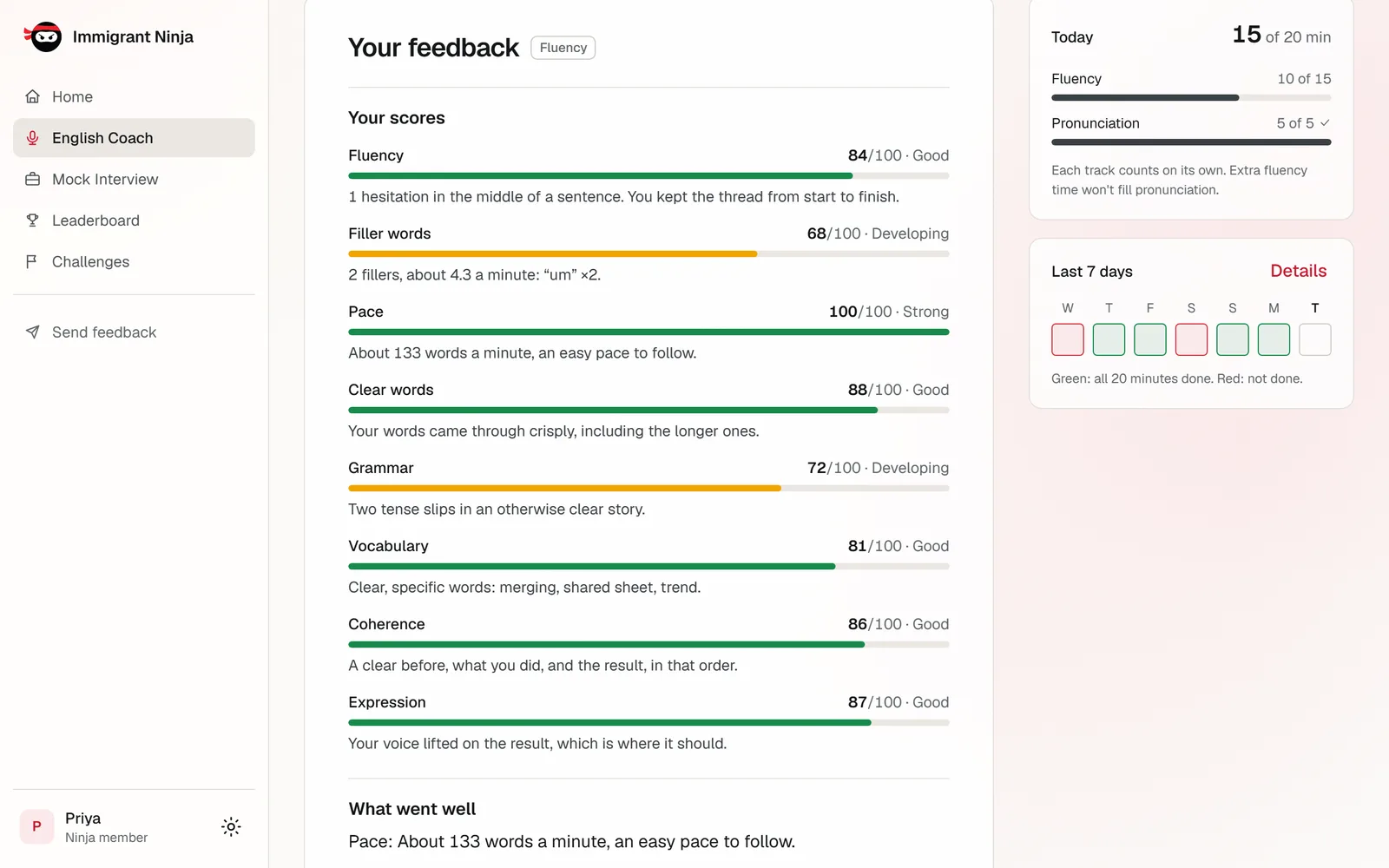
Feedback after a fluency recording: scores out of 100 for fluency, filler words, pace, clear words, grammar, vocabulary, coherence and expression, what went well, and the start of the grammar check, beside today's minutes and the last seven days.
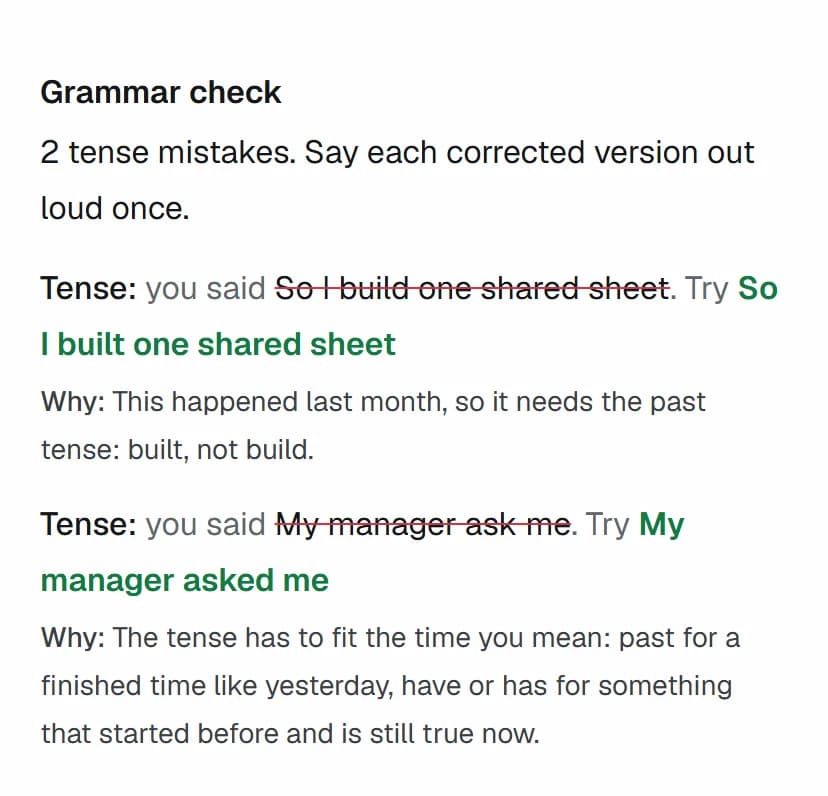
Grammar check: 2 tense mistakes. “So I build one shared sheet” is crossed out, with “So I built one shared sheet” and why: it happened last month, so it needs the past tense. The same for “My manager ask me”.
Each mistake, corrected and explained.
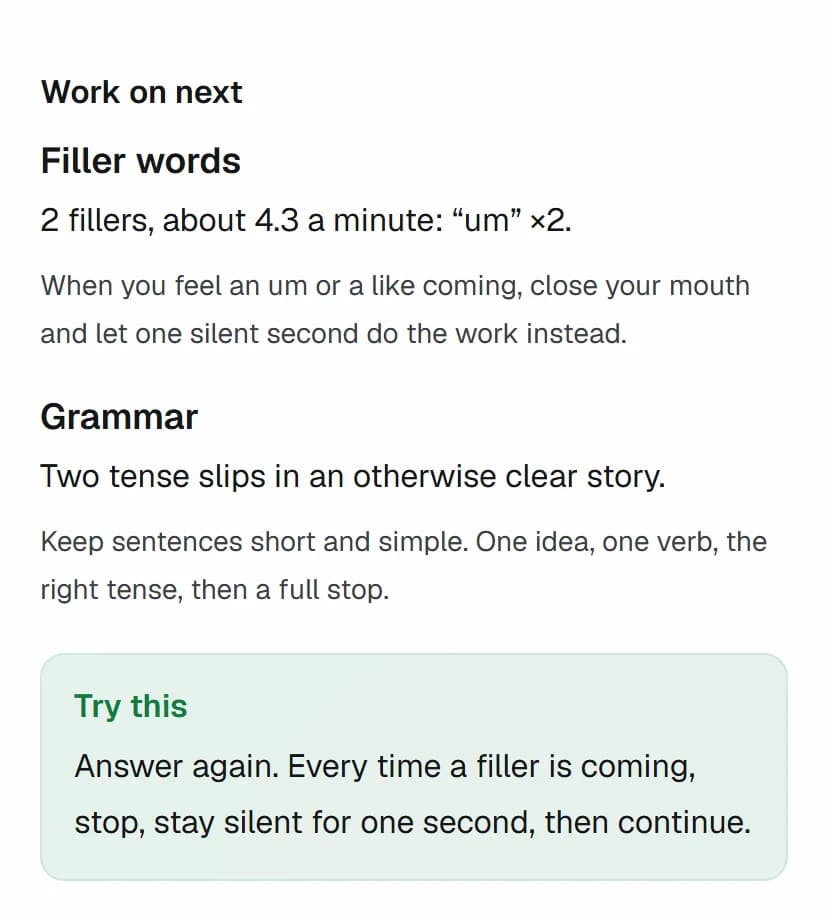
Work on next: filler words (2 fillers, about 4.3 a minute) with a tip, and grammar with a tip, then Try this: answer again, and when a filler is coming, stop and stay silent for one second.
What to work on, and one drill.
PRONUNCIATION

Practise the sounds
you find hardest.

Five minutes a day of reading short sentences aloud, built around one sound a week, like TH.

  1. Sentences built around your sound

    Everyday sentences full of this week's sound.

  2. Where the sound slipped

    The exact words where it slipped, and how to fix them.

  3. Four scores for every reading

    Sound accuracy, smooth reading, every word said, and rhythm.

  4. Hear the difference

    Play the model, then your own recording, back to back.
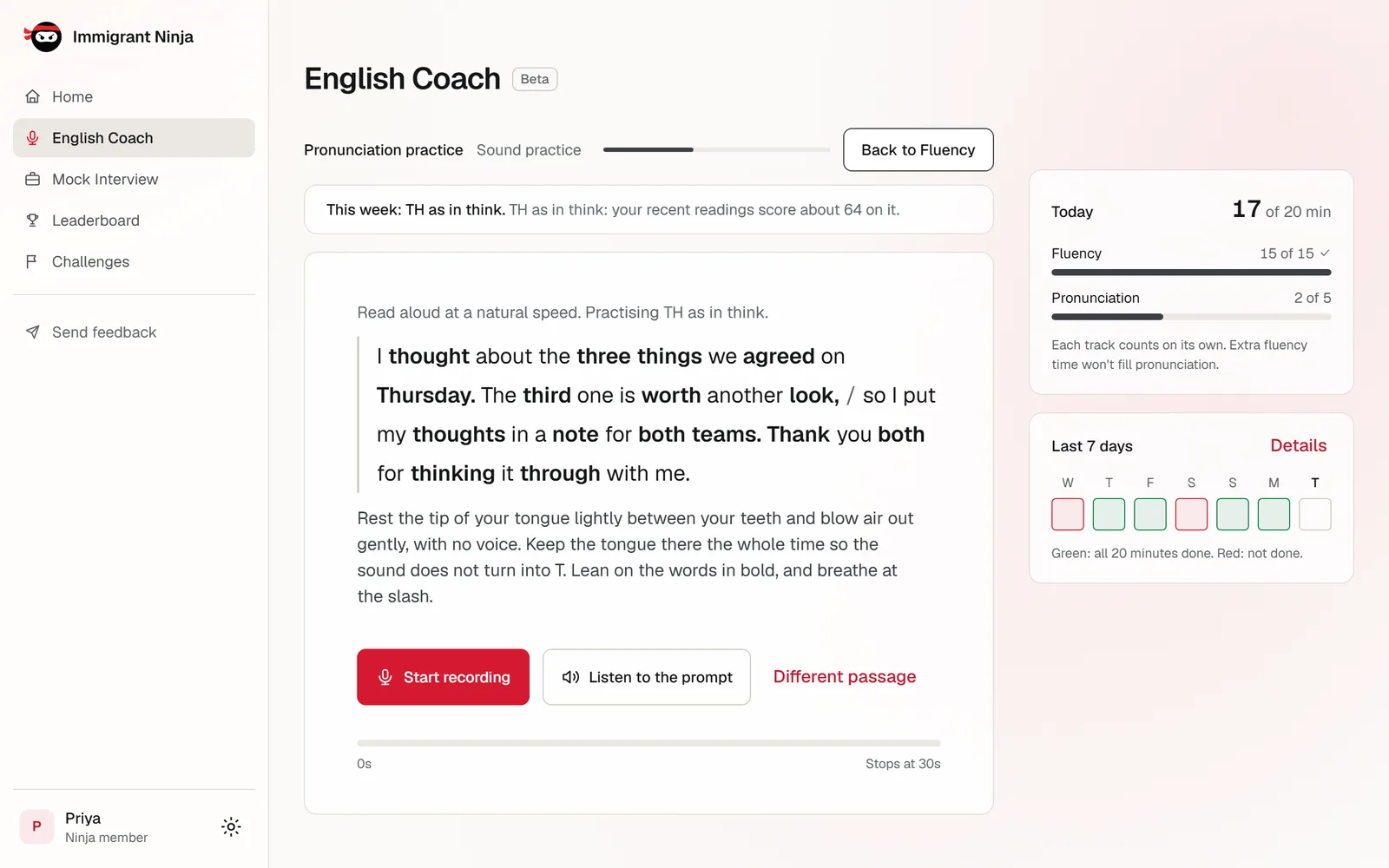
A pronunciation exercise for this week's sound, TH as in think, with the member's recent score on it: three sentences to read aloud, such as “Put three thick towels in the bathroom for both guests”, with how to make the sound, and buttons to record and to listen.
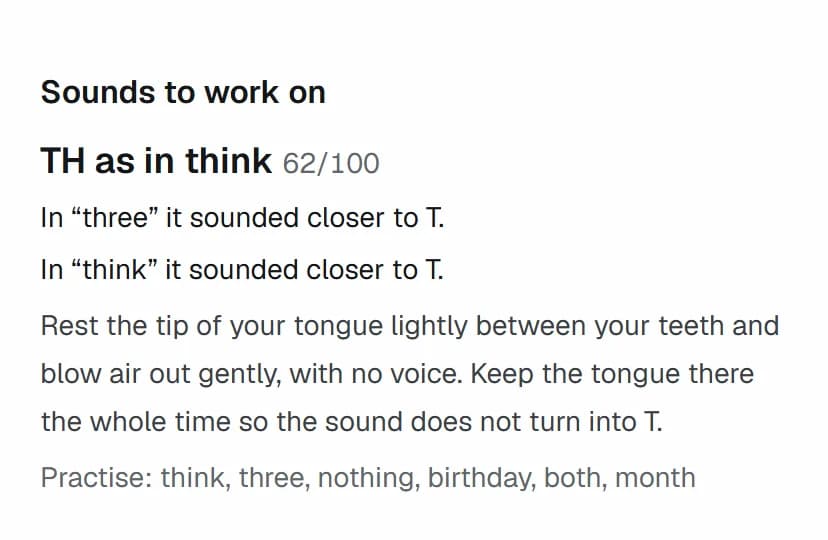
Sounds to work on: TH as in think, 62 out of 100. In “three” and in “think” it sounded closer to T, then how to make the sound and words to practise.
Where the sound slipped, and how to fix it.
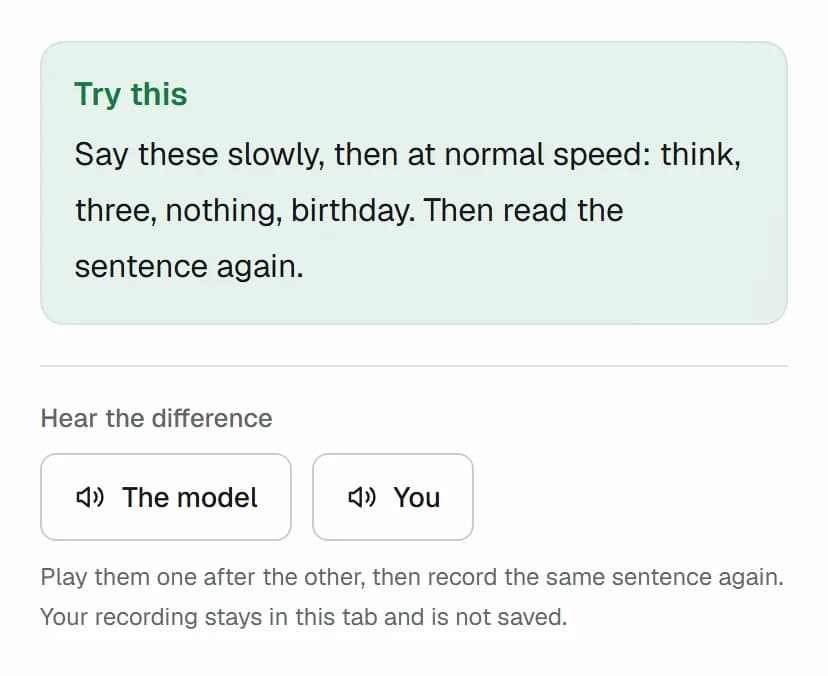
Try this: say think, three, nothing and birthday slowly, then at normal speed, and read the sentence again. Then Hear the difference, with buttons for the model and for your own recording.
Hear the model, then yourself.

See how each skill
has improved.

Every score is kept, so you can see each skill against where you started.

Scores over time for fluency: a line rising from about 60 in August to 84 today, marked Good, with the note: up 24 since 19 Aug, and your best yet.
Your practice: 6 of the last 7 days practised, a 2-day streak, 102 minutes this week, and a bar for every day against the 20-minute goal.

Mock interviews
for your role and company.

You answer out loud, like the real thing, and get a written report at the end.

These are practice. Your real mock interviews are with Ishank.
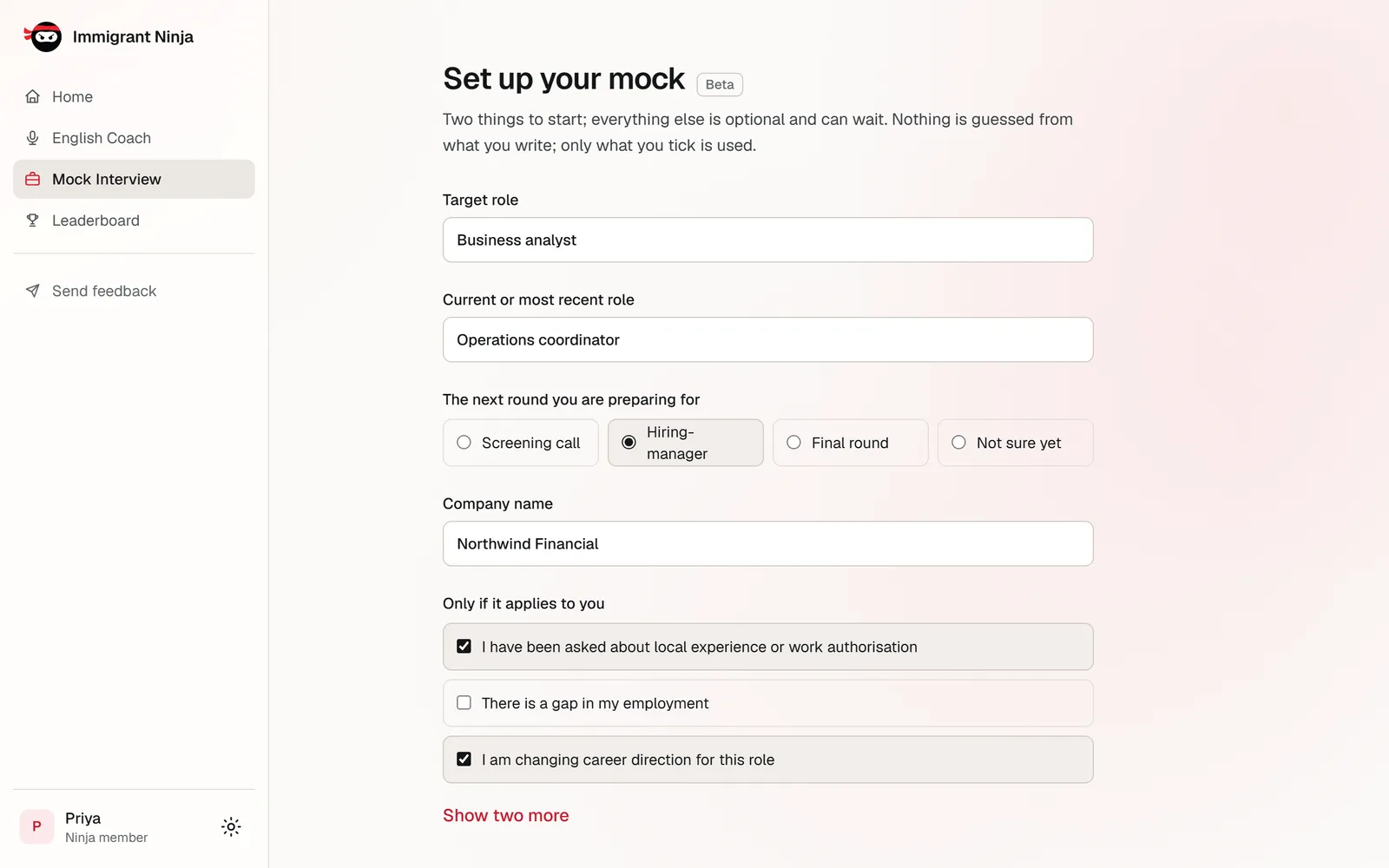
Setting up a mock: target role Business analyst, current role Operations coordinator, the next round (screening call, hiring-manager, final round or not sure yet) with hiring-manager chosen, company Northwind Financial, and what applies: local experience or work authorisation, and a career change.
  1. Set it up for your interview

    Your role, the company and the round. Paste up to three job postings and the hiring-manager mock asks from them.

    Name the objection you are worried about

    Tick what worries you, like a career change or a gap. The hiring-manager mock always asks about one.
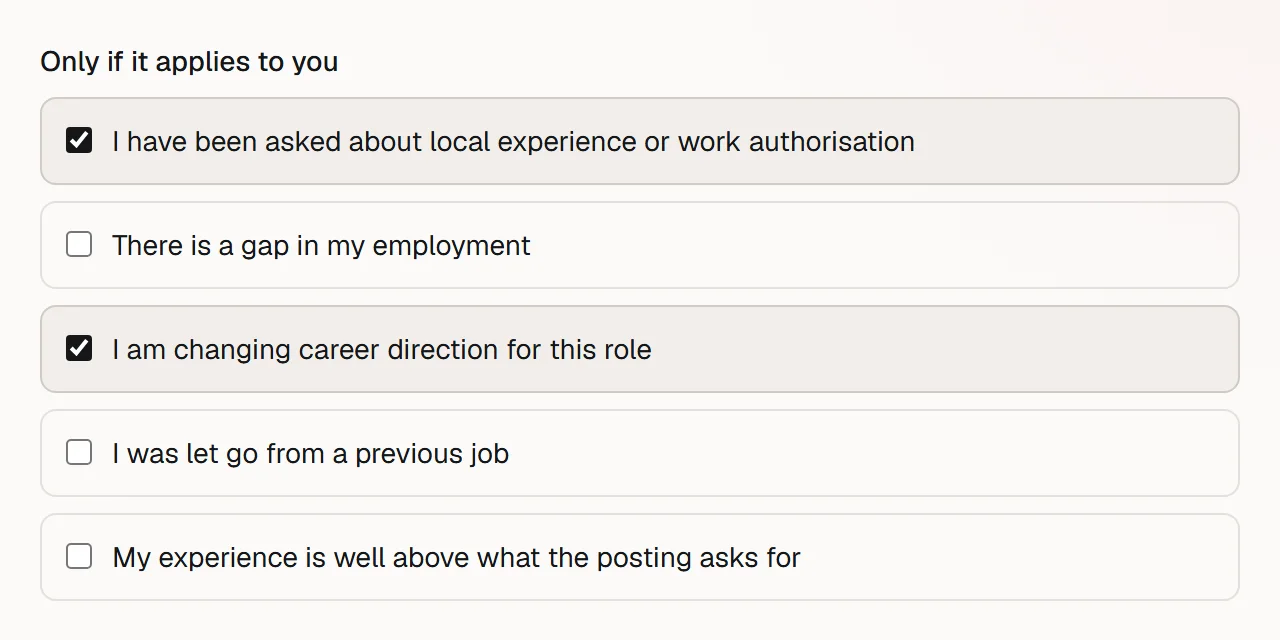
    The setup's “Only if it applies to you” list: asked about local experience or work authorisation (ticked), a gap in employment, changing career direction (ticked), let go from a previous job, and experience well above the posting.
    Only what you tick is used.
  2. Choose the length of the mock

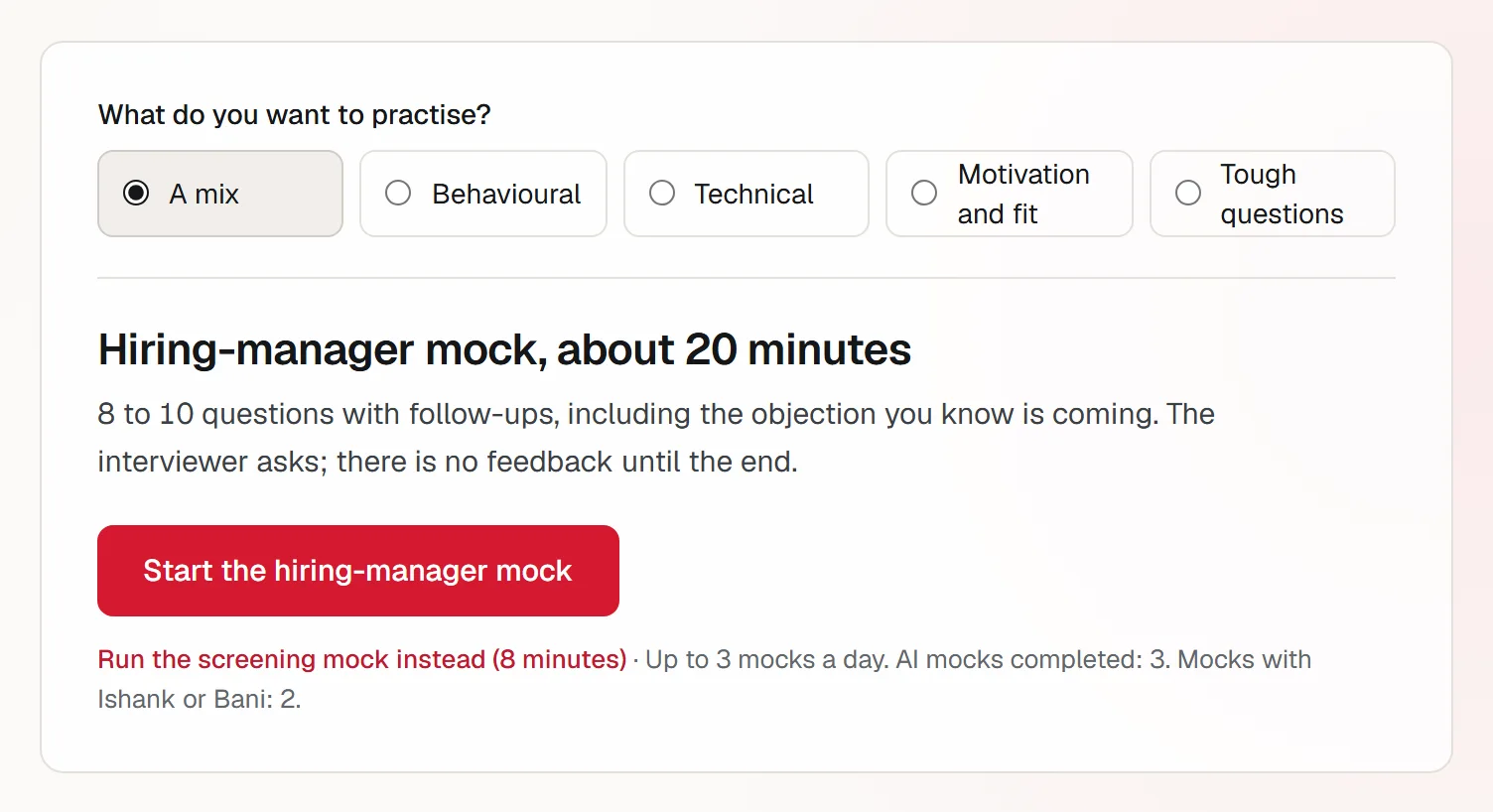
    A screening mock of about 8 minutes, or a hiring-manager mock of about 20.

    The recommended next mock: a hiring-manager mock of about 20 minutes, 8 to 10 questions with follow-ups including the objection you know is coming, with the screening mock as the alternative.
    The mock it recommends next.
  3. Answer out loud

    Each question is read aloud, with a guide to how long to answer.
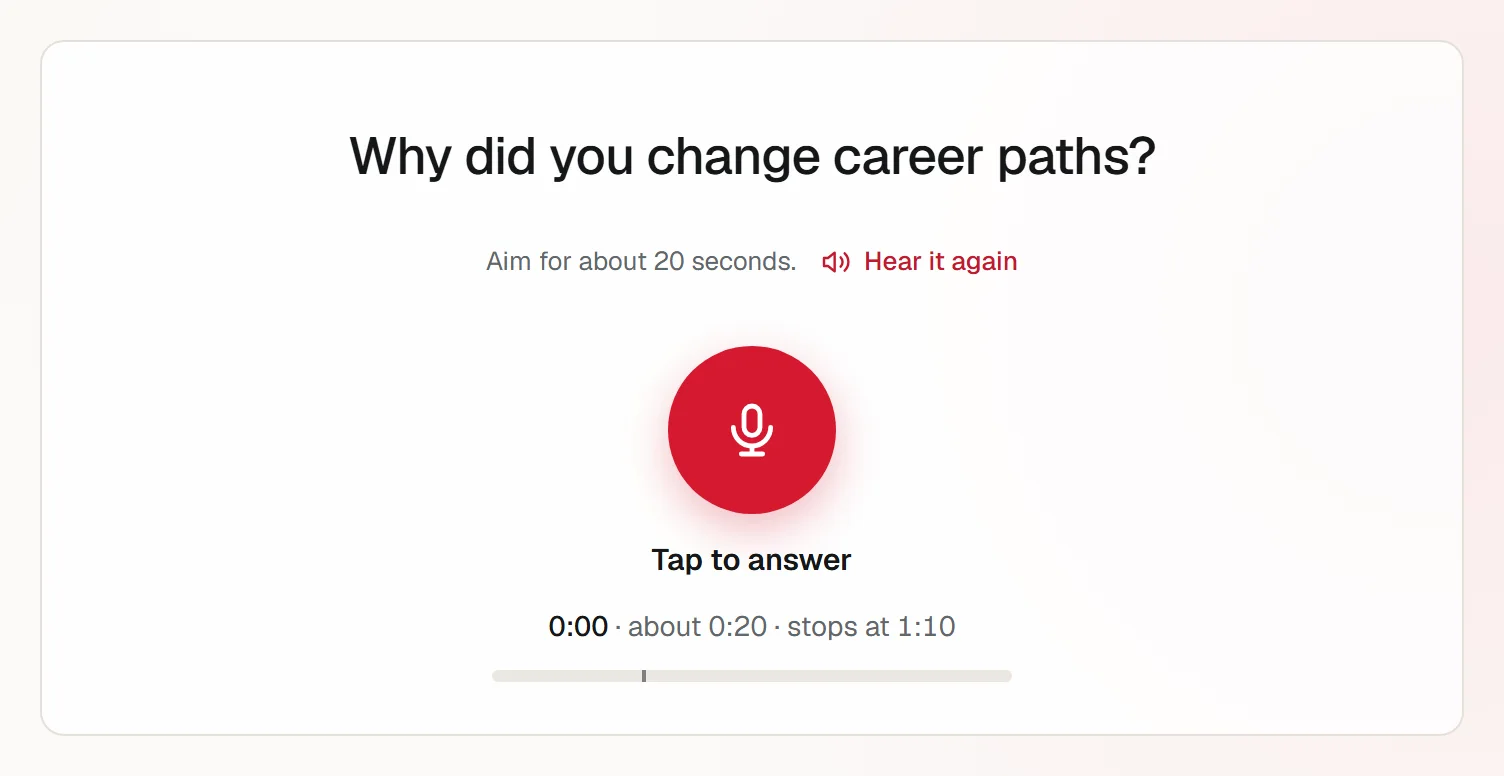
    A question in a hiring-manager mock: “Why did you change career paths?”, with “Aim for about 20 seconds”, a button to hear it again and a button to answer.
    A question, read aloud.
  4. Get a written report

    It starts with the one thing to fix, then covers every area, checked against Ishank's Interview Ninja book where it applies.
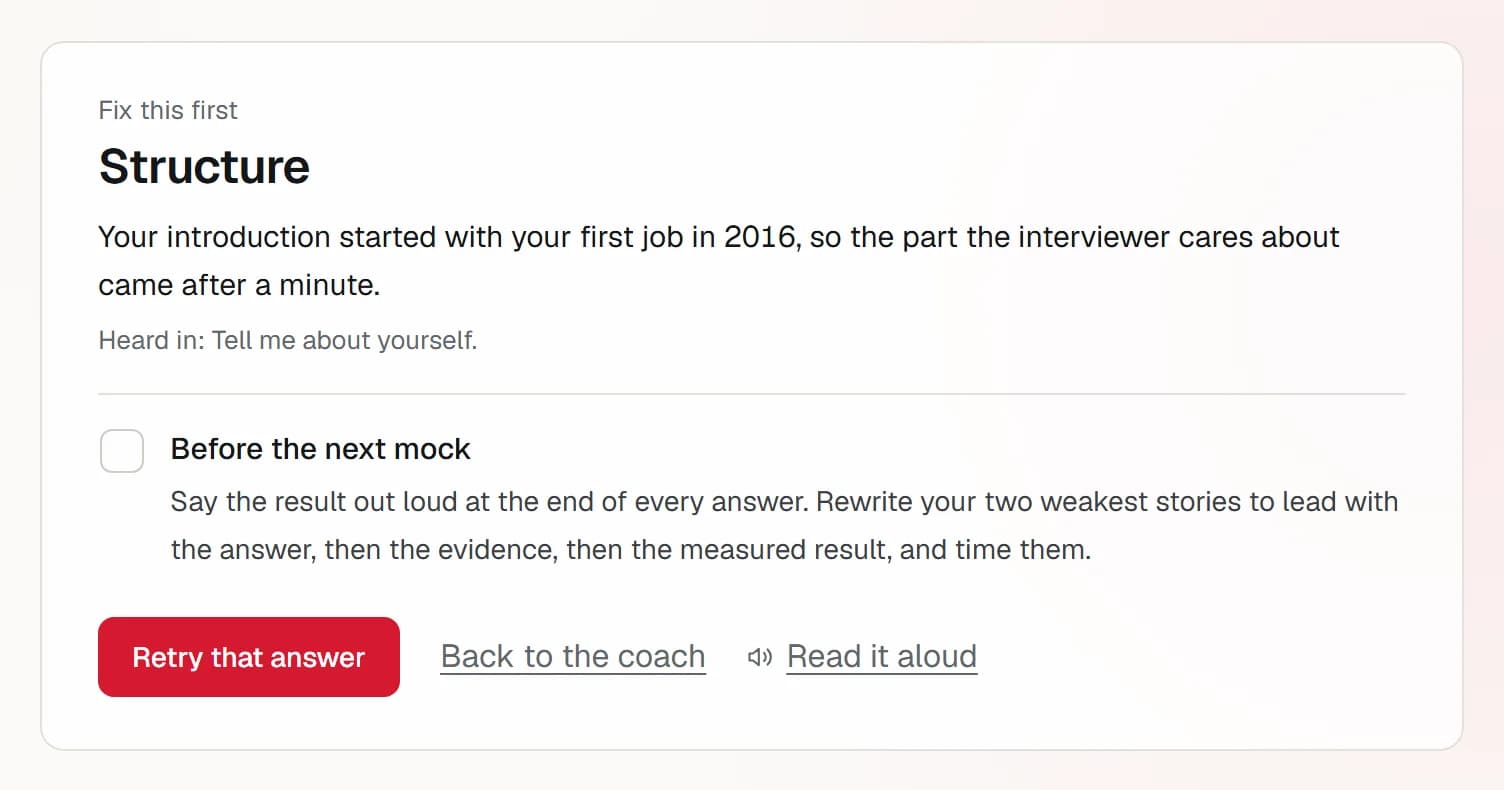
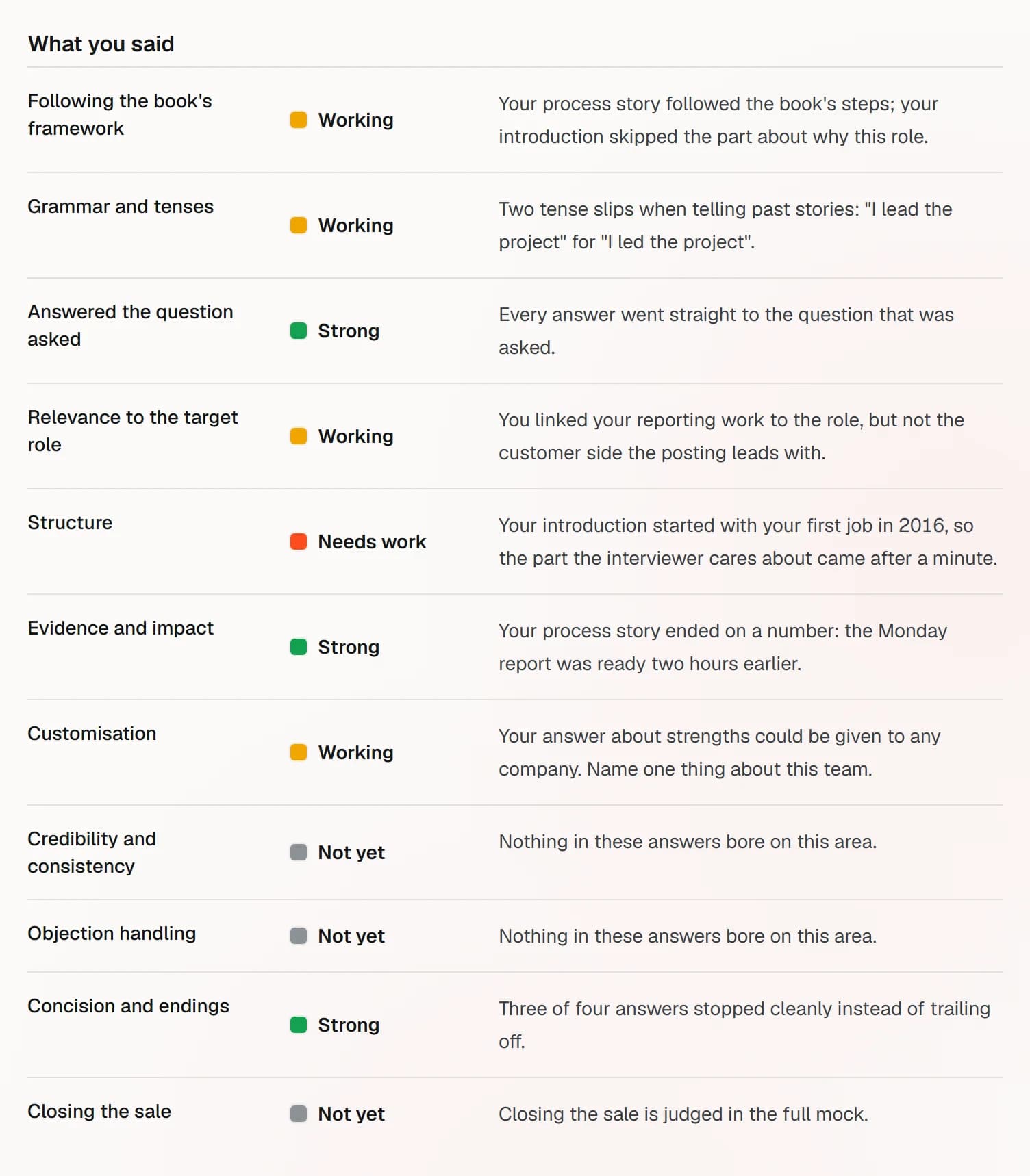
    Fix this first: Structure. The introduction started with a first job in 2016, so the part the interviewer cares about came after a minute. Before the next mock: a homework task, with a Retry that answer button.
    The report starts with one thing to fix.
    Every area of what was said, each marked Strong, Working, Needs work or Not yet with one line: following the book's framework, grammar and tenses, answering the question asked, relevance to the role, structure, evidence and impact, customisation, credibility, objection handling, concision and closing.
    Then every area, one line each.
  5. Watch each area improve

    See each area across your last five mocks, and retry your weakest answer.
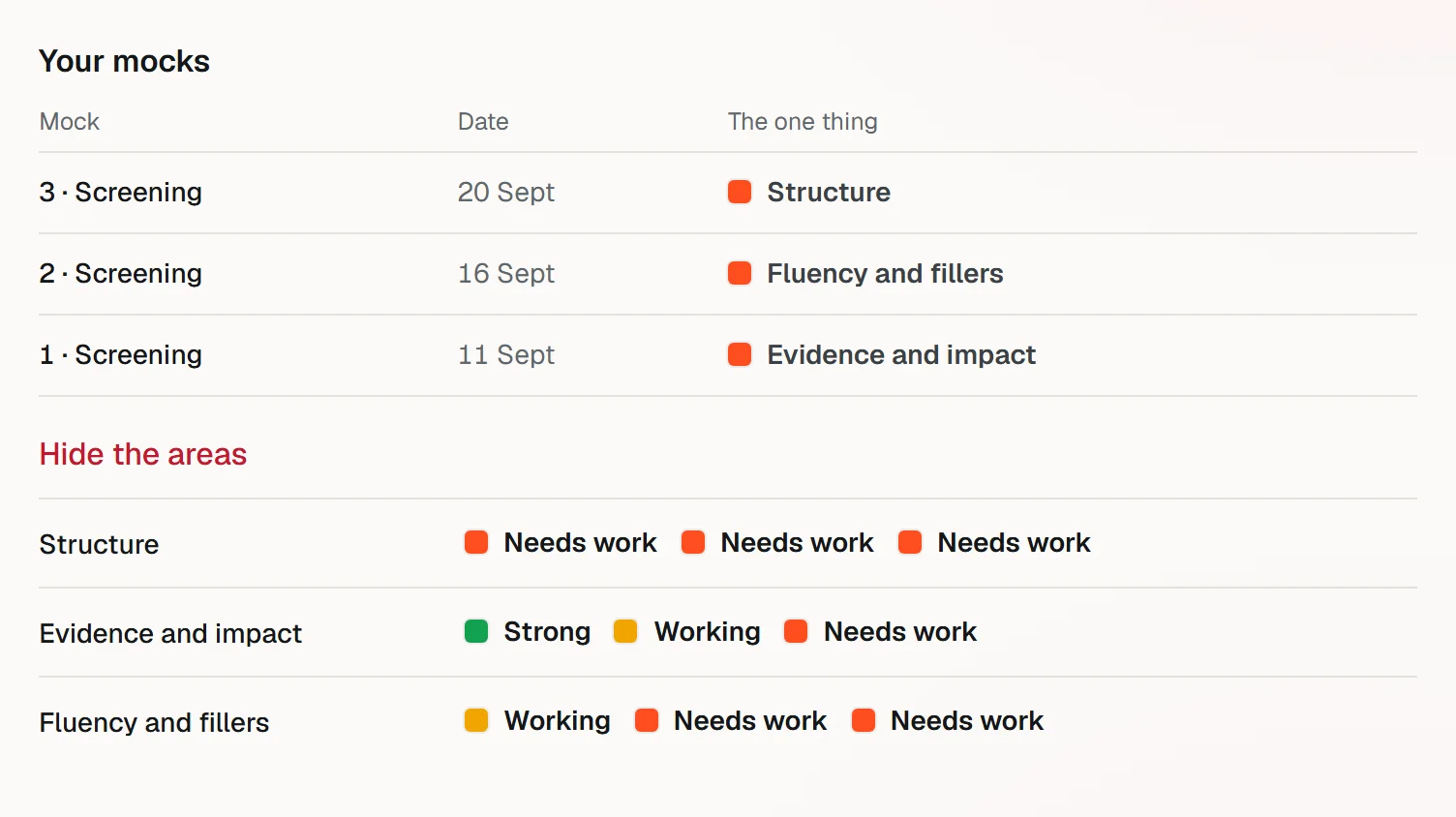
    Your mocks: three screening mocks with the one thing each needed, and structure, evidence and impact, and fluency and fillers shown across the last three mocks.
    Each area across your last five mocks.
LEADERBOARD

Practise every day
and move up the board.

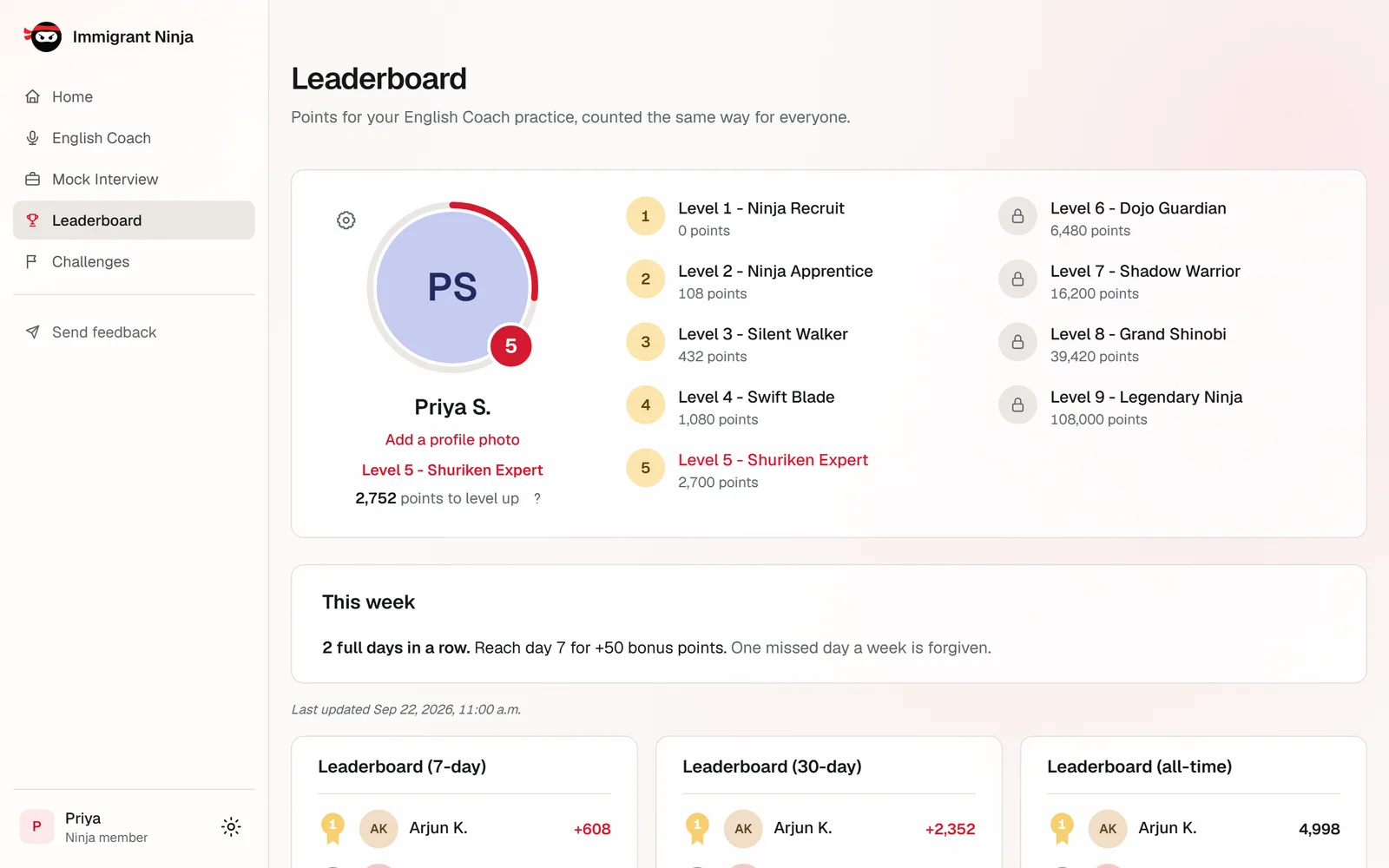
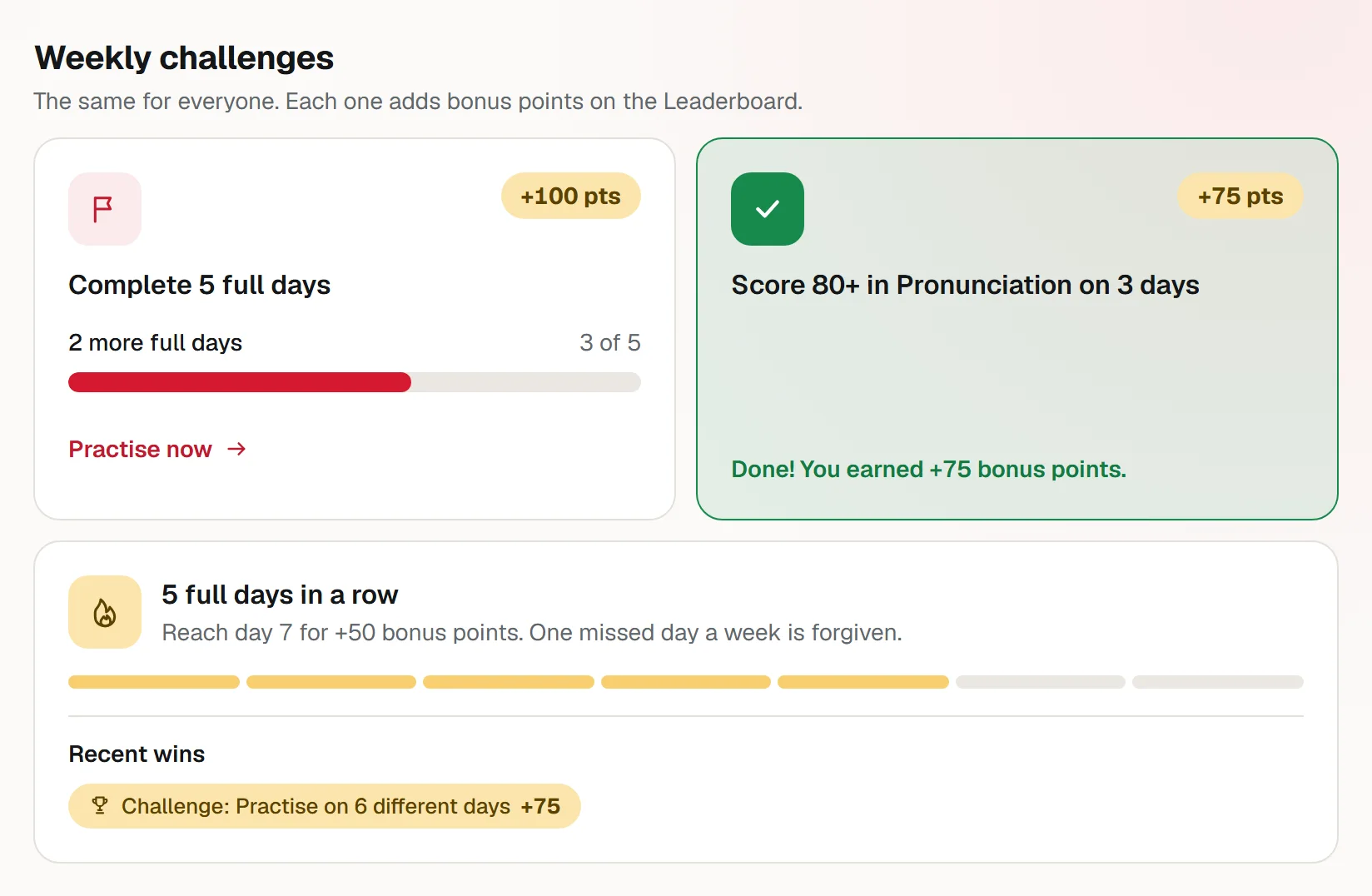
Daily practice earns points, streak bonuses and nine levels.

The leaderboard page: the member's level (Level 5, Shuriken Expert) among all nine levels, this week's streak, and the top of the 7-day, 30-day and all-time boards, where members appear by first name and initial.
An example board. The names are made up.

The app covers the days
between your sessions.

The app does not replace Ishank, Bani or your sessions. It is how you practise between them.

In your sessions

Ishank and Bani find what is holding you back. Ishank runs your real mock interviews.

In the app, every day

About 20 minutes of practice, with feedback as soon as you finish.

Together

The coaching team can review your practice, so sessions start where you are.

Your next chapter starts here.

Join the waitlist to hear when coaching reopens. The app comes with it.

Join the Coaching Waitlist